You finish a job, the customer is pleased, and you move on to the next appointment.
Months later, that same customer needs another service. Do they call you—or search Google again because they can't remember your company's name?
A past customer already knows something about your business. They've seen how you communicate, how your team works, and whether you deliver what you promise.
Keeping that relationship active gives them a convenient way to return when a real need arises.
For a plumber, electrician, HVAC contractor, cleaner, or landscaper, repeat business can come from useful reminders, relevant service information, and a clear path to scheduling.
Here's how to build a customer follow-up process you can maintain.
1Organize the Customer Information You Already Have
Start with your actual customer records: invoices, scheduling software, your CRM, or a spreadsheet.
For each customer, record the details you need to communicate appropriately:
Keep the information accurate and access limited to the people who need it.
A plumber's records might distinguish between a water heater installation, a drain-cleaning visit, and ongoing work for a property manager.
Those customers have different reasons to hear from you again.
Before launching a campaign, check which contacts are appropriate to include and which channels you may use. An old invoice with a phone number is not, by itself, a plan for sending promotional texts.
- Name and current contact information
- Service provided and completion date
- Property or service area
- Relevant equipment or project details
- Agreed communication preferences
- Marketing permissions and opt-outs
- Any open service issue
Your first task: organize a manageable group of past customers with reliable records.
2Separate Customers by What Is Relevant to Them
A single message to everyone on your list may miss the reason they hired you.
Create simple groups based on actual service history and customer needs.
For a plumbing business, those groups could include:
Keep estimates that never became jobs separate from completed customer work. They require different wording.
You can also group customers by service area, last completed visit, or a maintenance date that is actually recorded.
Avoid making assumptions from incomplete data. If you don't know whether a customer has a sump pump, don't send a message saying their sump pump is due for service.
- Customers with equipment you installed
- Customers who requested an estimate but did not proceed
- Homeowners who used you for a completed repair
- Property managers with multiple locations
- Customers enrolled in a genuine maintenance plan
Your first task: choose two or three groups that would benefit from different messages.
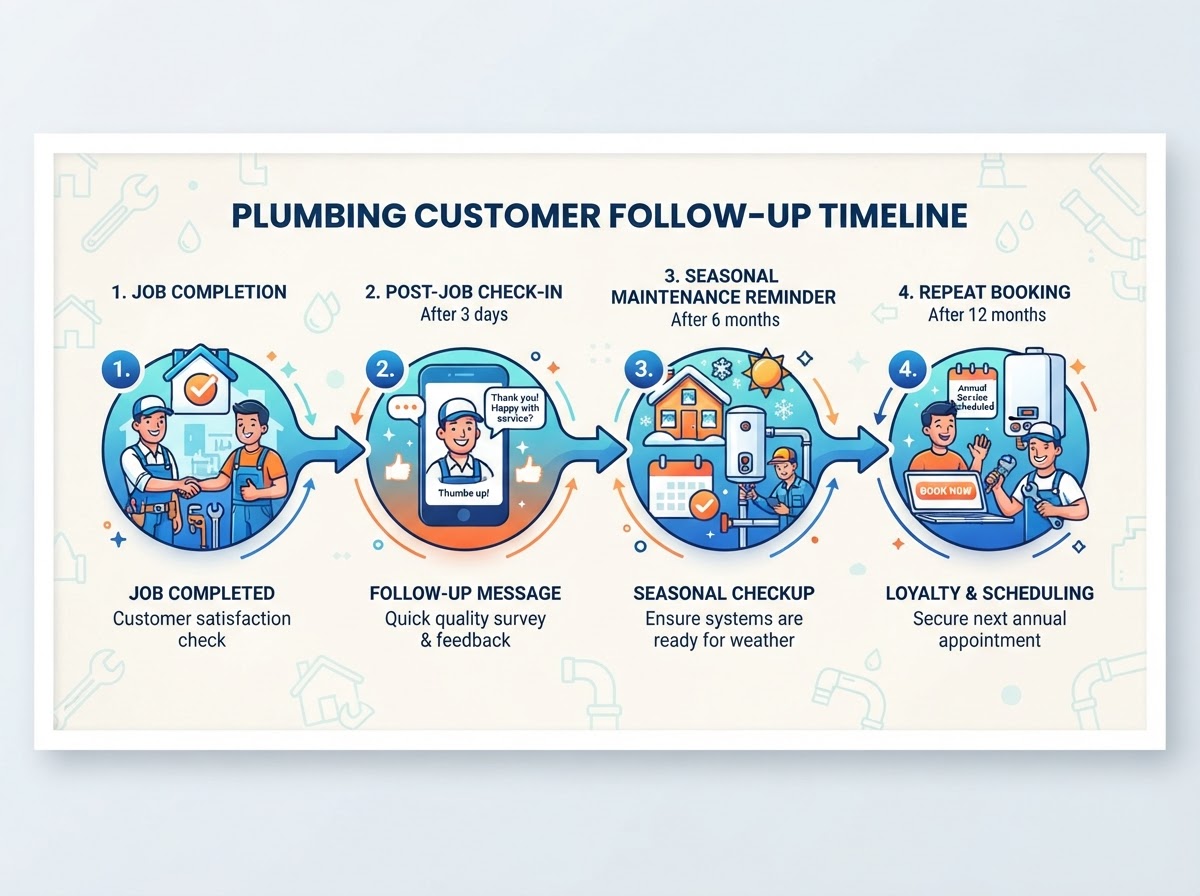
3Follow Up After the Job Before Asking for More Business
The first follow-up should help complete the customer experience.
A short check-in can give someone a way to raise a question about the work.
For example:
“Hi [First Name], this is [Business Name] checking in after your recent plumbing service. Do you have any questions about the work or the next steps we discussed? You can reply here or call us at [Phone Number].”
Send it through an appropriate channel at a time that makes sense for the job. A next-business-day check-in may be a useful starting point, but the timing should fit your process.
Assign someone to review replies. If the customer reports a problem, handle that concern rather than continuing with promotional messages.
You can also provide any promised instructions, documents, or warranty information.
Your first task: create a post-service check-in and decide who handles the responses.
4Remind Customers About Maintenance That Actually Applies
Customers may appreciate a reminder about a service they genuinely need or a maintenance plan they chose.
Base reminders on equipment information, manufacturer guidance, professional assessment, and the customer's agreed schedule.
For a plumber, that could mean following up on maintenance discussed during an installation or inspection. For a cleaner, it could mean an agreed recurring service. For a landscaper, it could be a scheduled seasonal visit.
Don't invent a universal service interval for equipment you haven't assessed.
A reminder might say:
Subject: A reminder about your planned maintenance
“Hi [First Name], When we completed your [Service], we discussed [Maintenance Item] around [Date or Interval]. If you'd like to arrange that visit, reply to this email or call [Phone Number]. We can review your current needs and confirm scheduling. Thank you, [Business Name]”
Your first task: identify one service where you already have a legitimate basis for a future reminder.
5Send Useful Seasonal Information
You don't need a discount every time you contact someone.
Send information that helps customers plan, with a relevant service invitation where appropriate.
A plumbing company could share a short reminder about arranging an assessment of exposed outdoor plumbing before freezing weather. An HVAC contractor could discuss preparing for the upcoming heating season. A landscaper could explain when it accepts bookings for a particular service.
Keep technical advice accurate and appropriate to the customer. Encourage professional help where needed.
Example email:
Subject: Planning ahead for colder weather
“Hi [First Name], As colder weather approaches, it may be a good time to review any outdoor plumbing concerns you've been putting off. If you'd like our team to assess the plumbing at your property and discuss appropriate preparation, reply to this email or call [Phone Number]. We're happy to explain the next step and check appointment availability. [Business Name]”
Send this only to a suitable audience. Someone who moved out of the area or opted out of marketing should not receive it.
Your first task: plan one timely message tied to a service you genuinely provide.
6Show Past Customers What Else You Can Help With
A customer who hired you to repair a toilet may not know that you also handle water heater replacement.
Use follow-up content to explain your services without pretending the customer has a problem.
For example:
Subject: Need help with another plumbing project?
“Hi [First Name], Thank you again for choosing [Business Name]. Along with the service we previously provided, our team also handles [Relevant Services]. If another plumbing question or project comes up, we'd be happy to discuss it. You can reply here or visit [Relevant Service Page] to learn more. [Business Name]”
Choose a short, relevant service list. Link to a useful page rather than making the email a complete catalog.
Real project photos and clear explanations can help customers understand what you do. If you use a customer's property or testimonial, obtain appropriate permission.
Your first task: identify one service your existing customers may not realize you offer.
7Create an Easy Way to Return
A helpful reminder can still fail if the customer has to work too hard to respond.
Give them one clear next step:
Be precise about what happens. An appointment request is not a confirmed appointment.
For work that needs assessment, use a request process rather than letting someone book a service you can't yet price or schedule accurately.
Keep forms short. A returning customer may only need to confirm contact details, describe the request, and provide their location.
Check the process on a phone, including the confirmation message and staff notification.
- Reply to the message
- Call a visible number
- Request a callback
- Request an appointment
- Book through an available scheduling system
Your first task: test the complete path from a customer email to a request your team can act on.
8Reconnect With Customers You Haven't Heard From
If your records and permissions support it, send a simple message to a relevant group of past customers.
Start with a real reason to reconnect: seasonal planning, a service they may find useful, or a straightforward reminder that your business is available.
Example:
Subject: Here when you need plumbing help
“Hi [First Name], This is [Business Name]. We previously helped you with [Accurate Service Description], and wanted to let you know we're available if another plumbing need comes up. If you have a project or question you'd like to discuss, reply to this email or call [Phone Number]. Thank you for choosing us, [Business Name]”
If your records don't reliably show the previous service, use simpler wording rather than inserting a guess.
Send to a small, appropriate group first. Check delivery, replies, and requests before expanding.
A lack of response doesn't mean a customer is unhappy. They may simply not need your service.
Your first task: choose one customer group and one relevant reason to reconnect.
9Automate the Timing While Keeping People Responsible
A CRM can help you send routine messages based on job completion, recorded dates, or customer groups.
A basic process might be:
Configure communication preferences, opt-outs, duplicate prevention, and sensible sending times.
Keep email and SMS permissions distinct. Include appropriate sender identification and opt-out options. Test that unsubscribe and stop requests work before launching.
Also coordinate campaigns. A customer shouldn't receive an overdue-service message after completing that service yesterday.
Human responses still matter. Assign responsibility for questions, complaints, and appointment requests.
- The job is marked complete.
- The customer record is updated.
- A suitable check-in is sent.
- A maintenance reminder is scheduled where relevant.
- A reply or new request is routed to your team.
- Promotional follow-up stops when it is no longer appropriate.
Your first task: build and test one workflow using your own contact record before enrolling customers.
10Measure Repeat Work and Customer Response
Track outcomes that help you judge the program:
Email opens alone are not a dependable measure of interest. A reply, booking, or completed job is more useful.
Use customer records to distinguish repeat customers from first-time customers and to identify which campaign, if any, contributed to the request.
A past customer may have returned without receiving your message, so avoid attributing every repeat job to marketing.
Compare the value of completed work with the cost and effort of the program. If you offer a promotion, account for the discount when assessing results.
- Messages successfully delivered
- Customer replies
- Service requests
- Appointments booked
- Repeat jobs completed
- Campaign and software costs
- Unsubscribes or complaints
Your first task: record a starting point and review repeat-customer activity monthly.
Do You Need to Offer a Discount?
A discount is one option, but a returning customer may primarily want convenient scheduling, clear information, and a company they trust.
Start by giving them a useful reason to contact you.
If you choose an offer, make the service, eligibility, dates, and exclusions clear. Don't publish an offer that costs more to fulfill than the business can support.
A recurring maintenance plan can also be appropriate if it provides genuine value. Explain what is included, what is excluded, how scheduling works, and any renewal or cancellation terms.
Choose the approach that fits your service and customer relationship.
What This Looks Like for a Plumbing Business
A plumber completes an installation and records the equipment, service date, and maintenance guidance discussed with the homeowner.
The customer receives a suitable post-job check-in. Any question goes to the office for a response.
When a recorded maintenance date approaches, a relevant reminder offers an easy way to request service.
Separately, customers who have agreed to receive marketing may hear about another service or a useful seasonal topic.
If someone books, the record updates so they don't continue receiving the same invitation.
The owner reviews requests and completed repeat jobs each month.
That process gives the business a practical way to stay in touch while respecting the customer's needs.
Start With One Group and One Message
You don't need to launch a year of campaigns at once.
Organize a suitable customer group, choose one helpful reason to contact them, and provide an easy next step.
Review the responses. Improve the process, then expand with relevant reminders and service information.
Your customer list represents real relationships. Treat each message as another part of the service experience.
Want Us to Handle Your Customer Follow-Up?
At NassauPros, we help local service businesses build and manage customer follow-up campaigns that support repeat business.
We can help organize customer groups, write branded emails and text messages, connect appropriate follow-up to your service workflow, and set up maintenance reminders based on the information you provide.
We also help configure communication preferences, response notifications, scheduling links, and stopping rules so the process fits how your business operates.
Our reporting helps you see customer responses and repeat bookings, with completed-job results where your records support them.
You focus on taking care of customers. We handle the campaigns and automation that help you stay connected.
Contact NassauPros for a customer follow-up assessment. We'll review your current process, identify useful opportunities to reconnect, and explain how we can manage the setup and ongoing campaigns for you.